Huazhuo Plastic Welding Expert

Boosting Bumper Production Efficiency: Ultrasonic Punching & Welding in One Integrated Process

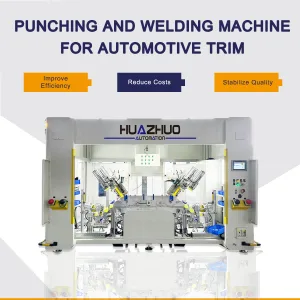
How Ultrasonic Punching and Welding Technology Transforms Bumper Hybrid Module Production
With the fast-growing demand for lightweight, precision-engineered automotive components, manufacturers are seeking equipment that can reduce cycle time, maintain tight tolerances, and ensure repeatable product quality. One of the most effective solutions is the ultrasonic punching and welding integrated machine, which combines multiple processes into a single automated workflow. This technology is especially valuable in the production of automotive bumpers, hybrid module assemblies, and plastic exterior parts.
In this article, we take an in-depth look at how the integrated process works—and why more automotive suppliers are adopting this innovative system to stay competitive.
Step-by-Step Overview of the Ultrasonic Punching & Welding Process
1.Hybrid Module and Bumper Insertion
The process starts with the operator placing both the hybrid module and the plastic bumper into a precision-engineered fixture.
The fixture is designed with:
- Positioning pins
- Contoured surfaces
- Mechanical clamps
to ensure stable, accurate placement. This step is crucial because even a small misalignment can affect downstream punching accuracy and welding strength.
2. Automated Transfer to the Punching Station
A servo-driven sliding table then moves the bumper assembly into the punching unit.
Servo motion ensures:
- Smooth transfer
- High positioning accuracy
- Repeatable movement
This automation minimizes manual intervention and reduces the risks of dimensional errors.
3. Punching and Radius Stamping — Performed with One Tool
At the punching station, a multifunction punching tool performs two operations simultaneously:
- Hole punching
- Radius stamping
This unified tool design enhances precision by keeping the part fixed in a single clamping state.
Technical benefits include:
- Reduced cycle time
- Lower tooling costs
- Consistent radius geometry
- Clean, burr-free punching edges
- Improved downstream fitment accuracy for the hybrid module
The result is a perfectly stamped hole with the required radius, essential for high-quality bumper assembly.
4. Inspecting the Post-Punching Result
After punching is completed, the machine provides a clear, uniform hole with integrated radius stamping.
Depending on configuration, a vision inspection or sensor verification system can be added to:
- Confirm hole dimensions
- Verify part presence
- Detect punching faults
This ensures that only compliant parts enter the welding phase.
5. Return to Starting Position for Welding
The servo sliding table retracts, bringing the bumper back to the original welding position. This synchronized motion eliminates unnecessary handling and keeps the production cycle continuous and efficient.
6. Counterholder Positioning for Structural Support
Before ultrasonic welding begins, the counterholder moves precisely into place.
The counterholder:
- Supports the backside of the bumper
- Maintains flatness
- Prevents deformation under ultrasonic pressure
- Ensures optimal energy transfer during welding
This step is especially critical for large, flexible plastic exterior components like bumpers.
7. Ultrasonic Welding — High Strength, Clean, and Repeatable
With the counterholder in position, the ultrasonic welding system activates.
During welding:
- The ultrasonic horn vibrates at high frequency
- Mechanical vibrations create heat at the weld interface
- Plastic material melts and bonds the hybrid module firmly to the bumper
Advantages of ultrasonic welding for bumpers include:
- Short weld cycles
- Clean and flash-free surfaces
- No need for adhesives or solvents
- Excellent mechanical strength
- Precise control of welding parameters (amplitude, pressure, time)
This makes it ideal for manufacturing automotive exterior components, structural bumper parts, and plastic hybrid assemblies.
Why the Integrated Process Matters for Automotive Manufacturers
By combining ultrasonic punching and welding into one automated workflow, this system offers major competitive advantages:
✔ Higher Production Efficiency
Two processes—punching and welding—are completed in one machine.
This reduces equipment quantity, floor space, and operator workload.
✔ Improved Accuracy and Repeatability
The part stays in the same fixture throughout the process, ensuring:
No secondary positioning errors
Higher dimensional accuracy
Stable weld strength
✔ Lower Cost of Ownership
Manufacturers benefit from:
Reduced tooling changes
Lower maintenance costs
Shorter cycle times
Fewer quality rejects
✔ Ideal for Automotive Bumper and Plastic Component Production
The system is widely used for:
Bumper hybrid module installation
Exterior trim welding
Large automotive plastic parts
Structural reinforcement modules
Decorative plastic covers
 English
  Chinese